The short answer
A typical Bangalore residential false ceiling installation runs 4 to 14 working days on site, depending on the system and the scope. Gypsum in a 3BHK apartment lands at 7 to 10 days; POP in the same scope runs 10 to 14 because of cure intervals between coats; a grid ceiling on a small office floor can be done in 4 to 6 days. Add 5 to 10 days of pre-install planning that most homeowners don’t see — measurement, design finalisation, material ordering — and the full project window is usually 3 to 4 weeks from first call to handover. Here’s what each phase involves.
What happens before installation starts
The 5 to 10 days of work before the first installer arrives are where most timeline slippage actually begins. A project that skips these days starts on time and finishes late.
Day 1 — site visit. A specialist walks the rooms, measures ceiling heights, checks the slab condition, notes the AC ducts, fan positions, and electrical points, and discusses the design brief. This is typically a 30 to 60 minute visit, free, and non-committal.
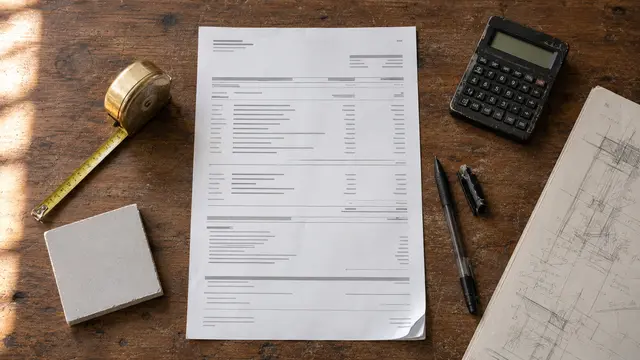
Days 2 to 4 — quotation. A written, itemised quote follows within one to two working days of the site visit. The quotation specifies brand, board thickness, framing brand, finish grade, area, and timeline line by line. A vague quote at this stage forecasts vague execution later — see our quote-reading guide for what every line should contain.
Days 5 to 8 — design sign-off and material ordering. The homeowner signs off on the design and finish choices, an advance is paid, and the contractor places material orders with their distributors. Standard Saint-Gobain Gyproc 12.5 mm and branded GypSteel framing are typically available next-day; specialty boards or imported VOX panels can add 3 to 7 days.
Days 9 to 10 — schedule confirmation. The contractor confirms the start date with the homeowner and the building society, schedules service-lift access for debris removal, and the installation crew is allocated to the project.
A homeowner who calls Nexus on a Monday usually has a confirmed start date for the following Monday or Tuesday — about 7 to 10 days from first contact.
Day-by-day breakdown for a typical 3BHK gypsum project
A standard 3BHK apartment gypsum ceiling — living, dining, master bedroom, two other bedrooms, with cove lighting in the living and dining — runs to roughly 1,400 sq ft of ceiling area and takes 7 to 10 working days on site.
Day 1 — Marking and framing setup. The crew arrives with laser levels, marks the ceiling drop heights on every wall, and fixes the perimeter wall channels. The slab-mounted hangers are drilled in for the main runners. End of day: the room reads as a grid of marks and a partial perimeter frame.
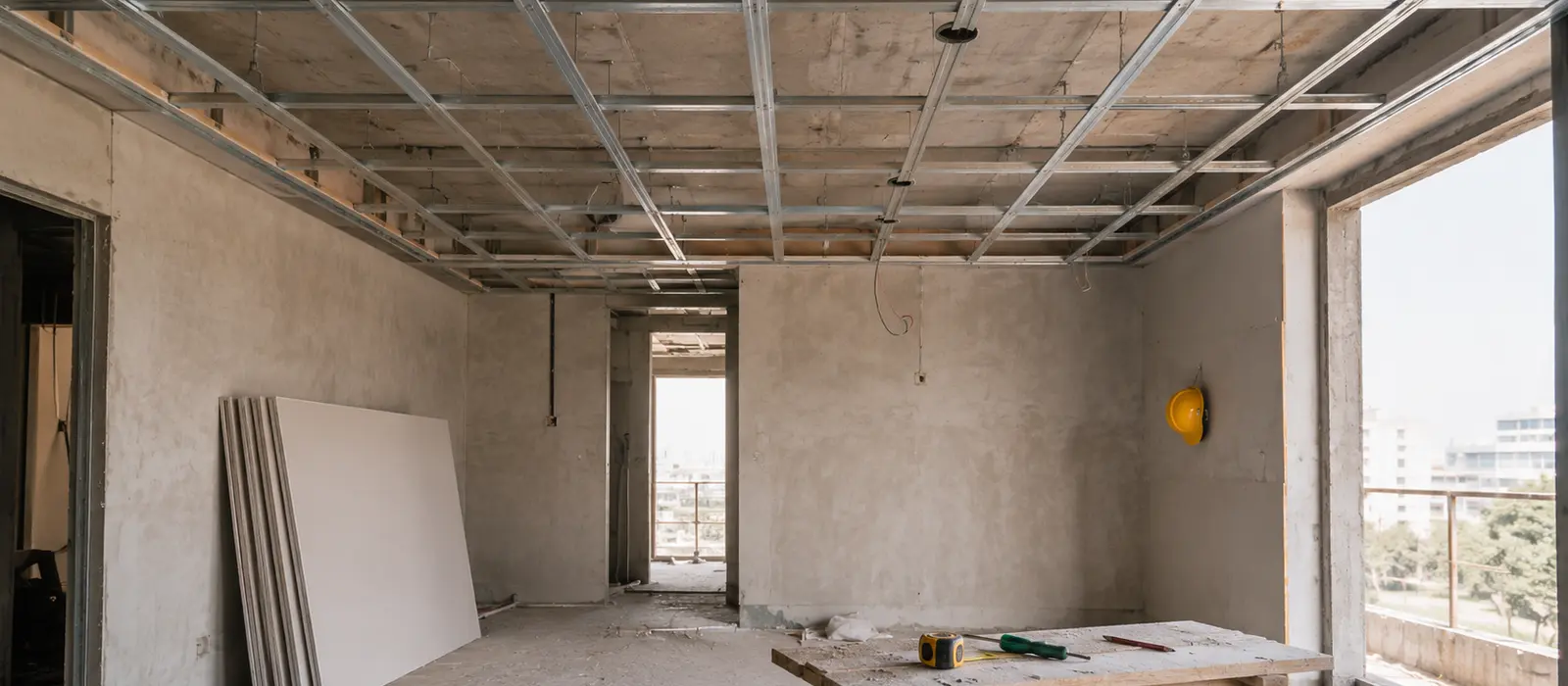
Days 2 to 3 — Framing completion. Main runners and cross- tees go up at the spec’d centres (typically 600 mm). Hanger spacing is verified, and the framing is checked for level across the rooms. End of day 3: every room has a complete sub-frame ready to take boards.
Days 4 to 5 — Board fixing. Saint-Gobain Gyproc 12.5 mm boards are cut to size and screwed up to the framing. Edges are butted with a controlled gap for joint compound. AC ducting and electrical points are cut around with templates. End of day 5: the rooms read as complete ceilings, but with visible joints.
Day 6 — Joint taping and first compound coat. Paper tape is embedded in the first coat of joint compound across every board joint. The compound is feathered out 4 to 6 inches each side. End of day: every joint is visible as a line of compound across the ceiling.
Day 7 — Second compound coat and sanding. The first coat is sanded smooth, the second coat goes on slightly wider, and is left to dry overnight.
Day 8 — Third compound coat and final sanding. The finishing skim. After this coat sets and is sanded smooth, the joints should be invisible. The cove edges are detailed at this stage.
Days 9 to 10 — Primer and handover prep. Alkali-resistant primer (Asian Paints, Berger, or Dulux) is rolled over the entire ceiling. The crew cleans up, removes debris, and hands over the ceiling to the painter, who follows up with finish paint over 1 to 2 days.
Total on-site time: 7 to 10 working days. Plus 1 to 2 days of painter follow-up after the crew leaves.
How POP timelines differ from gypsum
POP — Plaster of Paris — is wet-applied, and the cure intervals between coats are what extend the timeline. The same 3BHK project in POP runs 10 to 14 working days on site.
The framing is faster (a wooden batten frame with chicken mesh goes up in 2 to 3 days), but each of the three plaster coats — scratch, levelling, finish — needs 24 to 48 hours to cure before the next coat. Cornice work, if specified, adds another 2 to 4 days of skilled hand-laying. The finish coat dries for 2 to 3 days before primer.
POP is not slower because the trade is less efficient; it’s slower because the material chemistry requires cure time that gypsum board doesn’t. A contractor who promises a POP 3BHK in 7 days is either skipping cure intervals or substituting POP punning (a thin POP finish over gypsum board) and calling it a POP ceiling.
Grid ceiling timelines (for office readers)
A grid ceiling on a small Bangalore office floor — 800 to 1,200 sq ft, single-zone Armstrong mineral fibre tile install — runs 4 to 6 working days on site.
Day 1. Wall angle fixing and main runner suspension from the slab.
Days 2 to 3. Cross-tees and tile drop-in across the field.
Day 4. Cut-outs for lighting, sprinklers, HVAC diffusers, and access panels.
Day 5. Final levelling, snagging, and handover.
Grid ceilings are faster because the system is modular — no joint compound, no paint, no cure intervals. They’re also faster to re-modify after handover, which is part of why commercial projects favour them.
What can delay a project
The realistic delay risks fall into four categories:
- Material delays. Specialty board grades, imported VOX or wooden veneers, or fire-rated boards on commercial projects can add 5 to 10 days if the distributor is out of stock.
- Society approvals. Apartment societies sometimes restrict work hours, debris exit, or weekend installation. Worth checking before quoting.
- Site readiness. The work area needs to be clear of furniture, electrical points need to be exposed, and the client’s existing painter or AC technician needs to coordinate. A delayed AC service can push board fixing back by days.
- Weather. Bangalore’s monsoon adds humidity that slows compound and primer cure times. June to September installs are 1 to 3 days slower than dry-season installs.
What’s normal vs what’s a red flag
Honest contractors quote a realistic timeline and communicate delays. Less-honest ones make any of three patterns into a warning sign.
Promises that beat the realistic range. A 3-day full-3BHK gypsum install isn’t a competitive timeline — it’s a shortcut signal. Two compound coats instead of three, no sanding between coats, fewer hanger points, or thinner boards. The visible result at handover looks similar; the difference shows at the one-year mark when joint lines telegraph through the paint.
No timeline in the quote. A quote that says “approximately 2 weeks” without listing start and end dates leaves the contractor a free hand to slip the schedule. A real quote specifies the start date and the handover date, with payment milestones tied to phase completion.
Excuses after Day 3. Some weather and supply delays are real. Repeated vague excuses (“material delayed”, “labour issue”, “we’ll catch up”) within the first week usually mean the project was undersold on time to win the bid.
A contractor who promises 3 days for a full 3BHK gypsum ceiling is cutting corners somewhere. Ask which corners — and get the answer in writing before you sign.
Questions to ask before you sign
Before committing to a contractor, ask:
- What’s the on-site working day count for my scope?
- When is the proposed start date, and when is handover?
- What are the payment milestones, and which milestone unlocks handover?
- What happens if material delays push the schedule? Who absorbs the cost of a one-week slip?
- Will the timeline be written into the quotation, or will it remain a verbal estimate?
Every Nexus quote answers all five before you sign. A contractor who can’t is asking you to trust on faith — which is exactly the friction this guide is meant to remove.