Cement Sheet False Ceiling
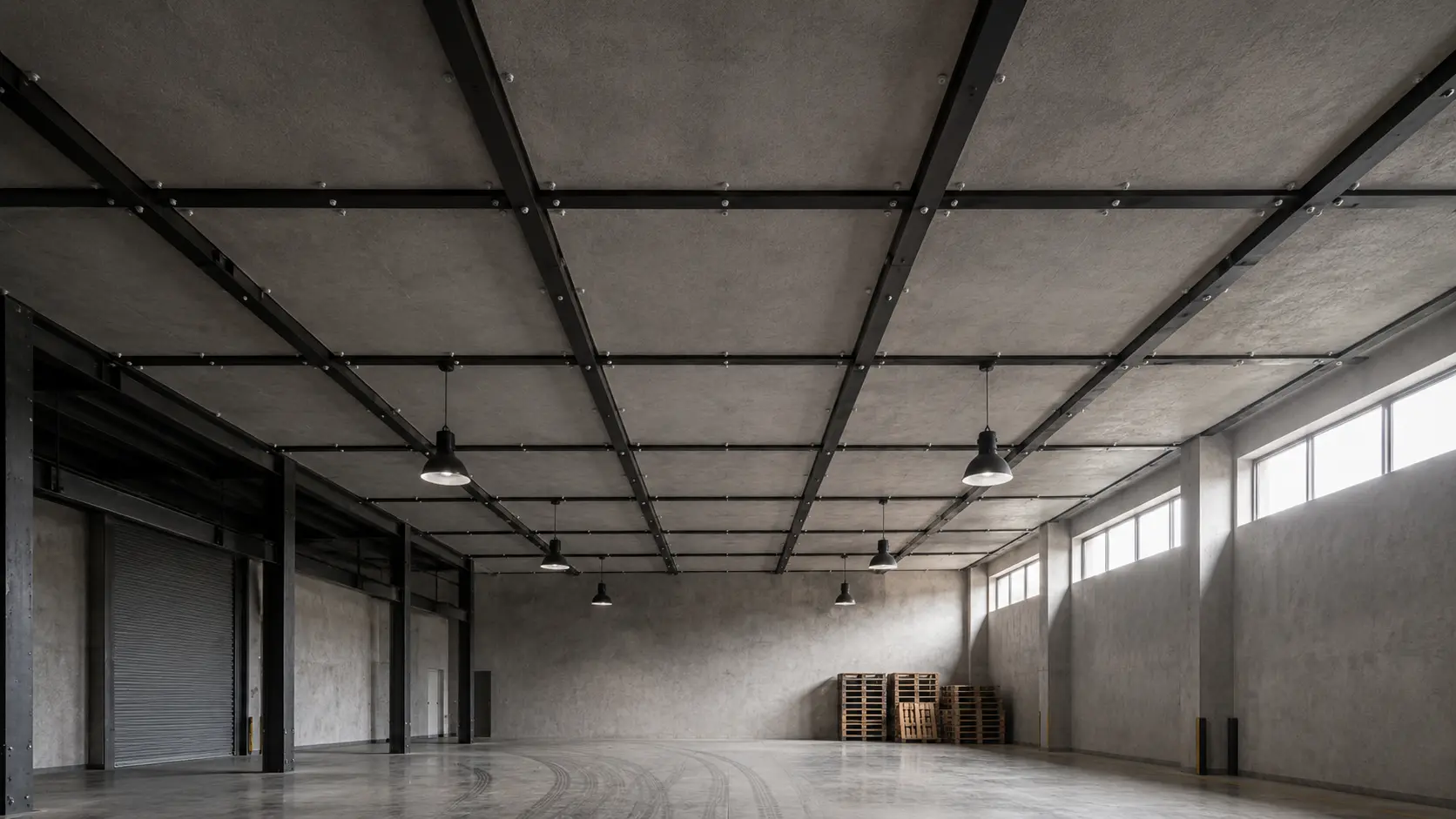
Cement Sheet False Ceiling in Bangalore
Fire- and moisture-resistant cement board ceilings for garages, server rooms, and exposed semi-outdoor areas where gypsum cannot survive.
15+ Cement Sheet Ceiling projects in Bangalore
What is Cement Sheet False Ceiling?
Cement sheet ceiling uses pressed cement composite boards — Portland cement combined with cellulose fibre and silica sand — as the visible ceiling surface. The boards are heavier and denser than gypsum, considerably more fire-resistant, and unaffected by sustained moisture exposure. They install on a heavy-duty metal sub-frame engineered for the additional board weight.
The system exists for the environments where other ceiling materials fail. Gypsum swells with moisture and cracks; POP crazes in humidity; PVC yellows under direct sunlight and cannot take fire-rating spec. Cement sheet boards handle all three problems: they hold dimensionally through monsoon humidity, carry a 2-hour fire rating at standard thickness, and survive UV exposure for years on semi-outdoor canopies and balcony soffits.
Install time is longer than gypsum — typically 8 to 14 working days for a balcony soffit or garage ceiling — because the boards are heavier to handle and the cutting requires carbide-tipped blades. The finish after painting reads similar to gypsum at a normal viewing distance, but the underlying performance is fundamentally different. Use cement sheet wherever the environment makes gypsum a maintenance problem.
Why Choose Cement Sheet False Ceiling?
-
Fire rating
Cement sheet boards carry a 2-hour fire rating at standard thickness — significantly above gypsum at the same dimension. Specified where the project demands non-combustible ceiling material: server rooms, garages, electrical equipment zones.
-
Moisture tolerance
The cement composite chemistry does not swell or absorb moisture from sustained humidity exposure. Balcony soffits, exterior canopies, semi-outdoor parking — all environments where gypsum would fail within a season — hold their finish over a decade.
-
Strength and pest resistance
Boards are dense enough to take fixture mounts (heavy lights, exhaust fans) without backing reinforcement that gypsum demands. Cement composite is also pest-resistant — no organic content for termites, rodents, or insects to colonise.
-
Long service life in hostile environments
A correctly installed cement sheet ceiling on a branded sub-frame lasts 15 to 20 years in the environments it is specified for — and longer in pure interior conditions. The combination of fire, moisture, and pest resistance is the practical justification for the higher install effort.
How We Install Cement Sheet False Ceiling
-
Site survey and environment assessment
A specialist visits, measures the slab or soffit, and reviews the environmental conditions — humidity, UV exposure, fire-rating requirement, fixture load expectations. The board grade and sub-frame spec are confirmed against the environment.
-
Heavy-duty sub-frame installation
A galvanised metal sub-frame is anchored to the slab at tighter spacings than gypsum demands (typically 450 mm centres versus 600 mm for gypsum) because of the heavier board load. For exterior applications, the framing is hot-dip galvanised for corrosion resistance.
-
Board cutting and fixing
Cement boards are cut with carbide-tipped blades — standard gypsum cutters are too soft. Boards are screw-fixed to the sub-frame with corrosion-resistant fasteners, joints staggered to avoid weak lines. The cutting and fixing pace is slower than gypsum but the alignment discipline is the same.
-
Joint sealing
Joints are sealed with cement-board-specific compound and reinforcing tape (gypsum compound does not bond reliably to cement composite). For exterior applications, the joint seal includes a moisture-tolerant filler under the surface compound.
-
Painting and handover
A specified primer seals the surface — alkali-resistant primer for cement substrate, gypsum primer will not bond properly. Paint coats follow per the project spec. Final handover includes the fire-rating documentation for any project records and a written warranty covering board sag, joint cracking, and moisture damage.
Materials We Use
-
Everest
India-manufactured fibre cement boards from one of the longest-established names in the segment. Consistent dimensional tolerance, dependable fire rating, and wide availability across Bangalore. The default specification for most cement sheet ceiling projects.
We use it for Standard fire-rated and moisture-tolerant ceilings, residential balcony soffits, commercial utility
-
Aerocon
HIL-manufactured fibre cement boards — slightly higher density than Everest and a smoother face that takes paint faster. Specified where the cement ceiling needs to read close to a gypsum visual register and where the higher density adds acoustic mass.
We use it for High-end residential balcony soffits, design-conscious cement ceilings
-
Ramco
Ramco fibre cement boards are widely specified on commercial and institutional projects where the documentation requirements are strict (fire-rating certificates, dimensional tolerance compliance). Their boards are the practical default for industrial ceiling applications.
We use it for Industrial ceilings, server rooms, garage soffits, institutional projects
Cement sheet ceilings need cement-board-specific everything: cutting tools, fasteners, joint compound, primer, paint. Substituting any of these with gypsum-grade equivalents shaves a few hours of install time and costs years of service life. The brand-specific system specification is what makes the ceiling perform to its rating.
Ideal For
Rooms
- Balcony and verandah soffits
- Garage and parking ceilings
- Server rooms and IT equipment zones
- Semi-outdoor canopies and porches
- Industrial back-of-house areas
Property types
- Independent villas (balcony soffits)
- Commercial garages and parking
- Industrial buildings
- IT infrastructure facilities
- Hospitality service zones
Cement sheet ceiling is the right specification anywhere gypsum would fail — exposed to weather, exposed to fire risk, exposed to long-term humidity. For pure interior dry-zone ceilings, gypsum remains the better choice; cement sheet is the upgrade for hostile environments.
Frequently Asked Questions About Cement Sheet False Ceiling
How is cement sheet ceiling different from gypsum?
Different chemistry and very different performance envelope. Gypsum is calcium sulphate (a soft, dimensionally responsive mineral) and excels in dry interior conditions where its fast install and smooth finish are the priority. Cement sheet is Portland cement composite (a hard, dimensionally stable mineral) and excels in fire-rated, moisture-prone, or semi-outdoor environments where gypsum would fail. The installations look similar after paint, but the underlying material is doing very different work.
Is cement sheet suitable for outdoor or semi-outdoor environments?
For semi-outdoor environments — balcony soffits, porch ceilings, verandah canopies, garage ceilings — yes, cement sheet is the right specification. The boards are dimensionally stable under sustained humidity and direct rain exposure on the underside is acceptable. For fully exterior applications with direct rain on the upper face (open eaves, fully exposed canopies), additional specification is needed: marine-grade framing, waterproofed top surface, and graded slope for drainage. We assess the exposure at the site visit and quote against the actual environment.
How does cement sheet differ from gypsum in fire-rating zones?
Standard cement sheet boards carry a 2-hour fire rating at typical 8 mm thickness — gypsum boards at the same thickness carry approximately 30 minutes. For projects with strict fire compartment requirements (server rooms, exit corridors, electrical equipment zones), cement sheet meets the spec where standard gypsum would not. Higher fire ratings (3-hour, 4-hour) are achievable with thicker boards and specific sub-frame configurations. We supply the rating documentation at handover for project records and any compliance review.
How long until the finished ceiling can be painted after installation?
Cement sheet ceilings can be primed and painted as soon as the joint compound is fully dry — typically 24 to 48 hours after joint sealing in standard Bangalore conditions. This is faster than POP (which needs 5 to 7 days between coats) but slower than the same-day paint readiness that PVC delivers. We sequence the painting to start once the joint compound passes a moisture-meter check rather than relying on time alone.
How long does a cement sheet ceiling last in Bangalore conditions?
A properly installed cement sheet ceiling on branded boards lasts 15 to 20 years in the typical environment it is specified for, and longer in pure interior dry-zone conditions. We offer warranties of up to 12 years on cement sheet installations, covering board sag, joint cracking, and moisture damage. Exterior balcony applications have slightly shorter warranty terms because the UV and rain exposure is harder to control over a long horizon — terms are confirmed in writing before the project begins.
Get a Free Quote for Cement Sheet False Ceiling in Bangalore
Tell us about your space — we'll send a written, itemised quote after a free site visit.