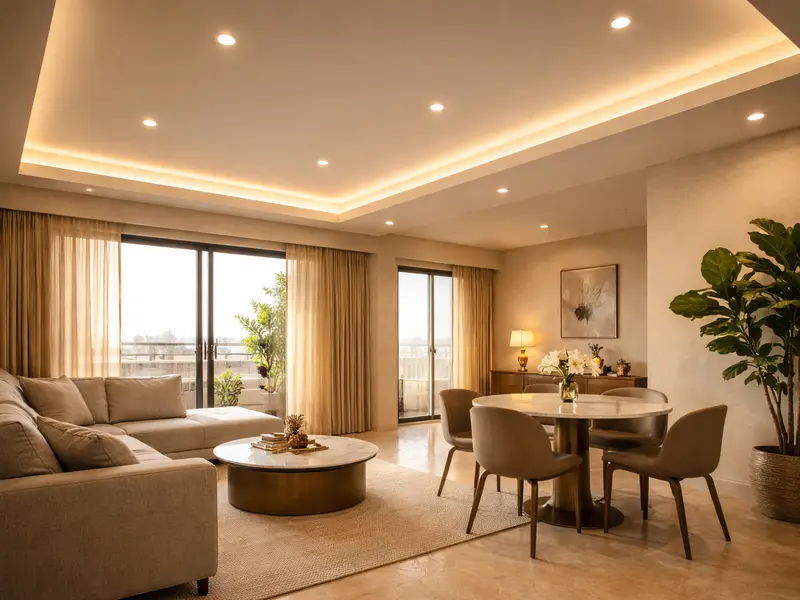
POP False Ceiling
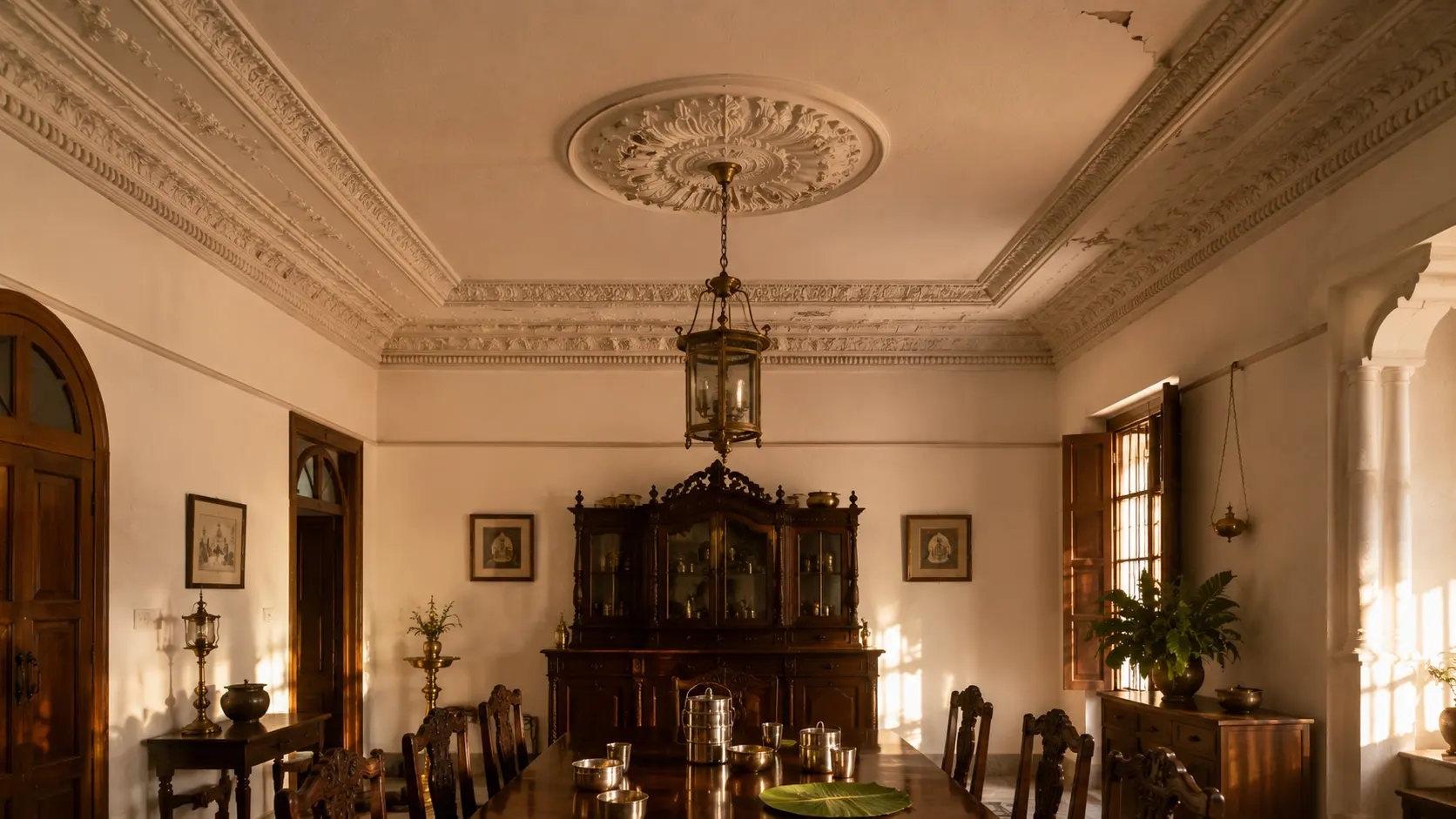
POP False Ceiling in Bangalore
Design-rich plaster of Paris ceilings — perfect for traditional cornices, classical patterns, and detailed plasterwork across Bangalore.
80+ POP Ceiling projects in Bangalore
What is POP False Ceiling?
Plaster of Paris is gypsum that has been heated until the chemically bound water leaves the crystal, then ground into a fine powder. When mixed with water on site, the powder rehydrates into a workable plaster that can be applied wet over a frame — completely different from gypsum board, which arrives at site as rigid factory-cut sheets.
The wet application is what gives POP its distinctive character. A craftsman builds up the ceiling layer by layer over a chicken-mesh-and-wood frame, working details in by hand — cornices, central rosettes, ribbons, fluted bands. Each layer needs days to dry before the next goes on. Where gypsum is a precision board system, POP is a hand-crafted plaster system, and the two are good at very different things.
A finished POP ceiling looks softer than gypsum — slightly hand-formed at the corners, with curves and reliefs that no factory-cut board can match. The classical cornice running around a Bangalore drawing room, the rosette under a central chandelier, the floral relief above a niche — these are POP's home territory, and they read as wholly unforced in a way gypsum never quite manages.
Why Choose POP False Ceiling?
-
Design freedom for curves and cornices
POP is wet-applied and hand-shaped, which means curves, ribbons, classical cornices, and decorative reliefs that gypsum cannot produce. Anything a plaster craftsman can sculpt becomes a permanent ceiling feature.
-
Traditional aesthetic
For drawing rooms, dining halls, and prayer spaces in heritage-style Bangalore homes, POP reads as the right material. The visual register matches the rest of the room — gypsum, however well executed, looks too clean for that context.
-
Wide labour availability
POP plasterers have been working in Bangalore for generations. The trade is deep, regional, and reliable. Repairs and small additions can be sourced locally without specialist suppliers — useful over a 20-year ownership horizon.
-
Easier to repair small areas
A damaged section of POP can be cut out, re-meshed, re-plastered, and feathered into the surrounding finish with no visible joint. Gypsum board repairs require board-edge taping that, in a textured environment, can read as a visible patch.
-
Hand-finished character
Two POP ceilings by two different craftsmen are never identical. The cornice profile, the depth of relief, the softness of curves — these are interpretive choices made on site. For homeowners who want a ceiling that isn't off-the-shelf, that's exactly the appeal.
How We Install POP False Ceiling
-
Site assessment and design discussion
A specialist visits, measures the room, walks through the intended POP design with you (cornices, rosettes, layered drops), and confirms the slab condition. No charge, no obligation.
-
Mesh and frame fixing
A chicken-mesh substrate is fixed to a wooden or steel sub-frame anchored to the slab. The mesh gives the wet plaster something to grip; the frame gives the whole ceiling its structure.
-
First POP layer
The base plaster layer is troweled on across the mesh, bringing the ceiling up to a uniform thickness. Detailed work — cornice profiles, rosette starts, layered drops — is roughed in at this stage.
-
Second layer with detailing
After the first layer dries (typically 2 to 3 days in Bangalore humidity), the finishing layer goes on. Cornice profiles are sharpened, rosettes detailed, reliefs deepened. This is where the craftsman invests the most hours.
-
Drying time
POP needs 5 to 7 days to fully dry between coats and before primer. Rushing this step is the single biggest cause of POP that cracks within a year. We commit to the drying schedule in writing and do not paint over wet plaster.
-
Final smoothening, primer, and handover
Once fully cured, the surface is gently sanded for finish, primed, and walked through with you under daylight and artificial light. We hand over with a written warranty.
Materials We Use
-
Sakarni
India-manufactured POP, widely used across South Indian residential work. Consistent grade, clean burn, dependable batch-to-batch. The default specification for most Bangalore residential POP installations.
We use it for Standard residential cornice and rosette work
-
Trimurti POP
Premium-graded POP with a finer particle size — produces smoother finishes and sharper detail edges. Specified where the design demands tight relief work or where the room has a long sightline that would expose any plaster grain.
We use it for Detailed relief work, drawing rooms with long sightlines
-
J.K. White
High-purity white POP used as a finishing coat over a base layer of standard POP. The brightest, smoothest finish available in the Indian market for plaster ceilings. Adds a single working day to the timeline and is worth it for paint-grade finishes.
We use it for Final coat where a brilliant-white paint base is required
POP looks deceptively simple in a finished room. The brand of plaster, the mesh gauge, the frame timber grade, the layer thickness, and most of all the drying schedule — these are what separate a POP ceiling that holds for 15 years from one that crazes within two monsoons.
Recent POP False Ceiling Work
A selection of finished pop false ceiling installations from projects across Bangalore.
Ideal For
Rooms
- Drawing rooms
- Dining halls
- Formal living rooms
- Foyers and entryways
- Prayer rooms
Property types
- Heritage-style homes
- Traditional Indian interiors
- Independent villas
- Older apartments built before 2010
- Hospitality with classical design
POP is the right ceiling when the room reads as traditional — drawing rooms, formal dining halls, classical interiors. For modern apartments built after 2010, gypsum is usually the better starting point; POP works best when its design vocabulary fits the rest of the room. We help you decide during the site visit.
Frequently Asked Questions About POP False Ceiling
How long does POP take to fully cure in Bangalore humidity?
A POP ceiling typically needs 5 to 7 days of drying between each plaster coat in Bangalore conditions — sometimes longer during peak monsoon when the air sits at 80% humidity for days at a time. We do not paint or prime over plaster that is not fully dry; doing so traps moisture under the finish and causes cracking within a year. The drying schedule is committed in writing before work starts, and the timeline already accounts for it.
How is POP different from gypsum false ceiling — what should I pick?
Gypsum is factory-made board on a metal frame — fast, flat, dimensionally precise, ideal for modern designs with crisp edges and concealed cove lighting. POP is wet-applied plaster on a mesh-and-wood frame — slower, hand-shaped, ideal for traditional cornices and decorative reliefs that gypsum cannot match. For most Bangalore apartments built after 2010, gypsum is the technically better choice. For heritage-style homes, drawing rooms with classical interiors, or any space where cornice work is the design intent, POP is the right answer. See our home FAQ for a high-level comparison; on this page we focus on POP specifics.
Will POP crack in Bangalore weather over time?
A properly cured POP ceiling on branded plaster and a sound sub-frame does not crack from Bangalore weather. Cracks, when they appear, trace back to one of three causes: rushed drying between coats (the most common), substandard plaster brand, or sub-frame movement from a poorly anchored wooden frame. We use Sakarni, Trimurti POP, or J.K. White on every project, give every layer its full drying time, and back the work with a written warranty against cornice or surface cracking.
How long does a POP false ceiling last?
A well-executed POP ceiling on branded materials lasts 12 to 15 years before any rework is needed — sometimes longer in rooms that stay climate-controlled. Repainting cycles are typical at the 6 to 8 year mark to keep the finish bright; the underlying plaster usually does not need touching at that interval. We offer warranties of up to 10 years on POP installations, confirmed in writing before the project begins.
Is POP suitable for kitchens or bathrooms?
No — POP is plaster, and plaster does not survive sustained steam or splash exposure. The right answer for kitchens, bathrooms, balconies, and utility rooms is PVC false ceiling, which is moisture-resistant by design and snap-fits in a day or two. Use POP for drawing rooms and formal spaces; let PVC handle the wet zones.
Get a Free Quote for POP False Ceiling in Bangalore
Tell us about your space — we'll send a written, itemised quote after a free site visit.