Gypsum Partition
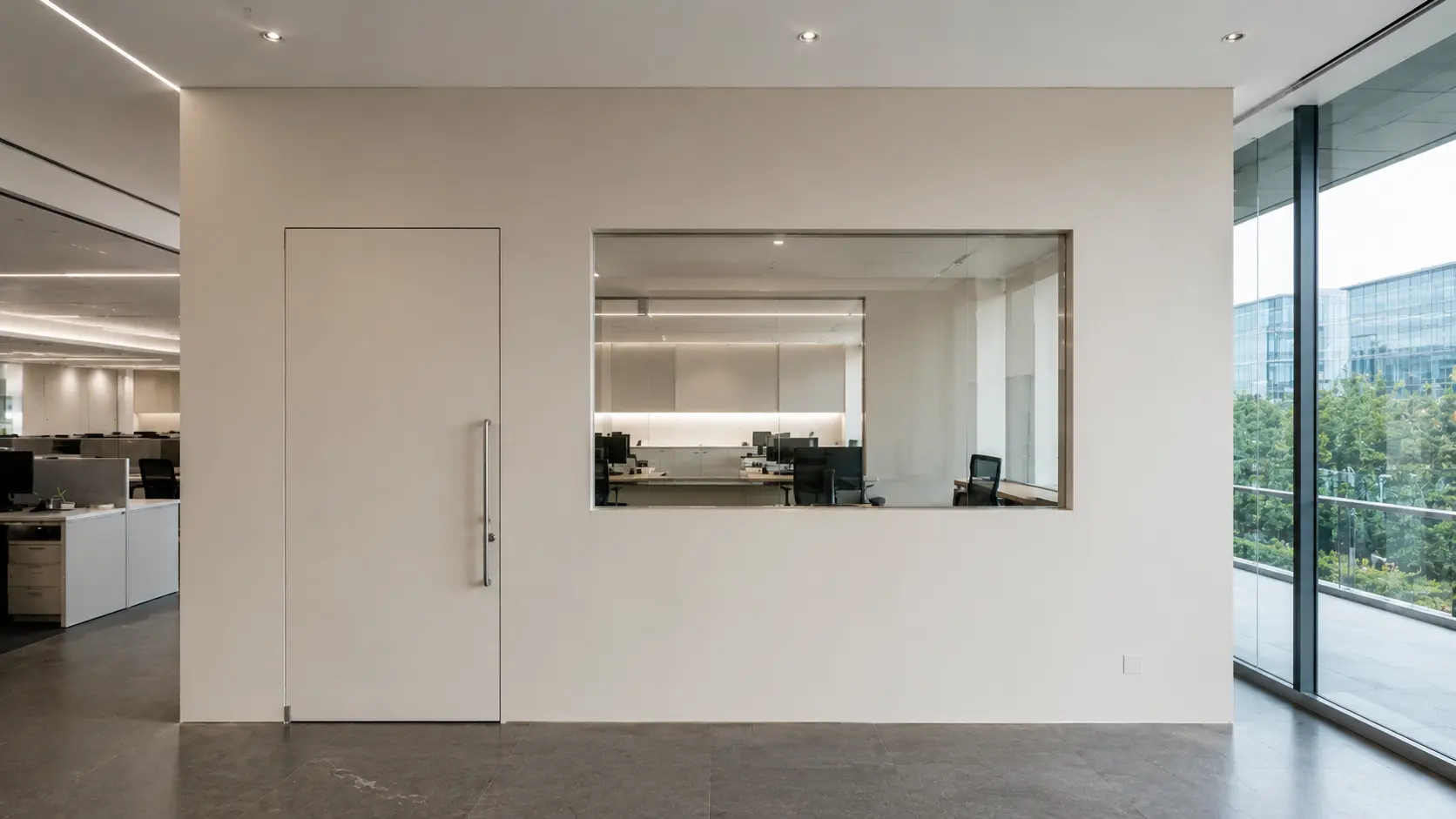
Gypsum Partition Walls in Bangalore
Lightweight gypsum partition walls on metal stud framing — faster, cleaner, and lighter than masonry. Office cabins, home subdivisions, retail fit-outs.
50+ Gypsum Partition projects in Bangalore
What is Gypsum Partition?
A gypsum partition is a non-load-bearing vertical wall built from galvanised metal studs anchored to the floor and ceiling tracks, then clad on both sides with gypsum board. The cavity between the boards can stay hollow or carry acoustic insulation. The whole assembly weighs a fraction of a brick wall of the same dimensions — typically 25 to 30 kg per square metre versus 200+ for brick.
The system has three advantages that brick cannot match. First, speed: a full-height office partition with a door installs in 5 to 9 working days, versus weeks for masonry. Second, cleanliness: there is no wet trade, no plaster splatter, no curing time, and the site stays usable during installation. Third, reversibility: when the office layout changes (and it will), a gypsum partition can be unscrewed and relocated without demolition rubble.
What gypsum partitions cannot do is hang heavy fixtures from arbitrary points. The board itself takes paint and light fittings without complaint, but a wall-mounted TV or a heavy shelf needs to land on a stud — which is why partition layouts include planned stud spacing for known fixture positions. We confirm fixture intent at the site visit so the stud layout supports what you actually need, not a generic grid.
Why Choose Gypsum Partition?
-
Speed of installation
A standard office partition with door and insulation installs in 5 to 9 working days. Brick equivalent takes three to four weeks including plaster cure time. For active office and retail spaces, the difference is whether the room is usable next week or next month.
-
Reversibility
Office layouts change. A gypsum partition can be unscrewed, the boards salvaged or replaced, and the studs relocated without demolition rubble or wet trades. The same is impossible with a brick wall.
-
Light load on slab
25 to 30 kg per square metre versus 200+ for brick. In multi-floor commercial buildings and apartments where slab loading is a real constraint, gypsum partitions add capacity without structural review.
-
Acoustic options with insulation infill
The cavity between the two board faces can be filled with Rockwool or glass wool, lifting the wall STC rating to 45–50 — comparable to a brick wall of the same thickness. For conference rooms and home study spaces, this is the partition that lets people work undisturbed.
-
Clean construction site
No wet plaster, no curing time, no dust beyond what a vacuum handles each evening. The site remains usable during installation — important for occupied office buildings where adjacent teams cannot stop work.
How We Install Gypsum Partition
-
Site planning and layout marking
A specialist visits, measures the space, and lays out the partition lines on the floor — marking door positions, electrical runs, and any planned fixture-mount points. Confirmed with you before any framing begins.
-
Floor and ceiling track fixing
Galvanised steel U-tracks are anchored to the floor and ceiling along the partition line. These define the run and serve as the receiver channels for the vertical studs.
-
Stud erection
Vertical metal studs slot into the floor and ceiling tracks at standard spacing (typically 600 mm centres, tighter where fixtures will mount). Door frames are integrated at this stage, with reinforced studs flanking the opening.
-
First side board fixing
Gypsum boards are screw-fixed to one side of the stud frame, top to bottom, with joints staggered to avoid weak lines. Electrical conduits and switch boxes are pulled through and the openings cut as boards go up.
-
Insulation infill
Rockwool or glass wool insulation is pushed into the cavity from the open side, friction-fit between studs. This is the moment for acoustic performance — skip it and the wall behaves like a drum.
-
Second side board, taping, finishing
The second face is boarded, joints taped on both sides, and the surfaces skim-coated to paint-ready smoothness. Door is hung, hardware fitted, and the partition is walked through with you under daylight and artificial light before handover.
Materials We Use
-
Saint-Gobain Gyproc
France-headquartered, manufacturing in India for decades. Gyproc boards and Gyproc-specified metal framing form a system designed to work together — board edges, screw spacing, and stud profile dimensions all matched. The default specification for residential and standard commercial partitions in Bangalore.
We use it for Standard residential and commercial partitions
-
USG Boral framing systems
Joint venture between US Gypsum and Boral, with manufacturing in India. USG Boral framing is widely specified by architects on high-spec commercial projects where the stud gauge and edge tolerance matter for acoustic or fire-rated performance.
We use it for High-spec commercial, fire-rated partitions, acoustic-critical rooms
-
Rockwool / Glass wool insulation
The insulation that turns a hollow partition into an acoustic partition. Rockwool offers higher density and slightly better fire performance; glass wool is lighter and more cost-effective. We specify by use case — conference rooms get Rockwool, residential subdivisions usually get glass wool.
We use it for Cavity insulation for acoustic and thermal performance
Partition performance lives in the system, not the board alone. The same Gyproc board on USG Boral framing with Rockwool insulation behaves completely differently from the same board on unbranded studs with no infill. If a quote does not specify framing brand and insulation grade, you do not yet have a finished quote.
Ideal For
Rooms
- Office cabins
- Conference room separation
- Home study and home office rooms
- Retail fit-out subdivisions
- Reception area enclosures
Property types
- IT and corporate offices
- Co-working spaces
- Retail showrooms
- Residential subdivisions
- Clinics and consultation rooms
Gypsum partition is the right choice anywhere you need a non-load-bearing wall fast, with acoustic options, and the possibility of relocating it later. For permanent load-bearing structure, masonry remains the answer. For wet-zone partitions (washroom walls), use cement sheet partition instead.
Frequently Asked Questions About Gypsum Partition
How does a gypsum partition compare to brick on acoustic performance?
A standard hollow gypsum partition without insulation is acoustically weaker than brick — about STC 30 versus 45 for a 4-inch brick wall. Add Rockwool or glass wool insulation to the cavity and the gypsum partition jumps to STC 45–50, matching or exceeding the brick wall in the same thickness. For conference rooms and home study spaces, the insulation infill is the difference between a usable acoustic separation and a wall that lets through every phone call.
Can a gypsum partition be load-bearing or hold a wall-mounted TV?
Not load-bearing in any structural sense — gypsum partitions carry only their own weight and any fixtures attached to them. They can absolutely hold wall-mounted TVs, shelves, and standard fixtures, but the mount must land on a stud (the metal vertical inside the wall), not just the board. We pre-plan stud positions for known fixture locations during the layout stage — confirm your TV position and shelf intent at the site visit and we set the stud layout accordingly.
How reversible is a gypsum partition if the office layout changes?
Genuinely reversible. The boards unscrew from the studs without destroying them; the studs unbolt from the tracks; the tracks lift off the floor and ceiling with minimal floor damage (one row of screw holes, easily patched). The boards themselves are usually scrap once removed (the cut edges and screw holes make reuse impractical), but the framing system is fully reusable. Most layout changes mean salvaging the studs and tracks, buying fresh boards, and reinstalling in a week.
Is gypsum partition suitable for wet areas — bathrooms, kitchens?
No. Gypsum boards absorb moisture and degrade under sustained splash exposure, and the steel framing inside the cavity will rust if water gets in. For washroom walls, kitchen partitions, and any wet-zone subdivision, use cement sheet partition instead — same construction system, different board, designed for moisture exposure.
How long does a gypsum partition last?
A properly installed gypsum partition on branded boards and framing lasts the life of the room — typically 20+ years before any rework is needed, and that rework is usually a layout change rather than a material failure. We offer warranties of up to 15 years on gypsum partitions using Saint-Gobain or USG Boral systems, covering board sagging, joint cracking, and any acoustic insulation settlement.
Get a Free Quote for Gypsum Partition in Bangalore
Tell us about your space — we'll send a written, itemised quote after a free site visit.