PVC False Ceiling
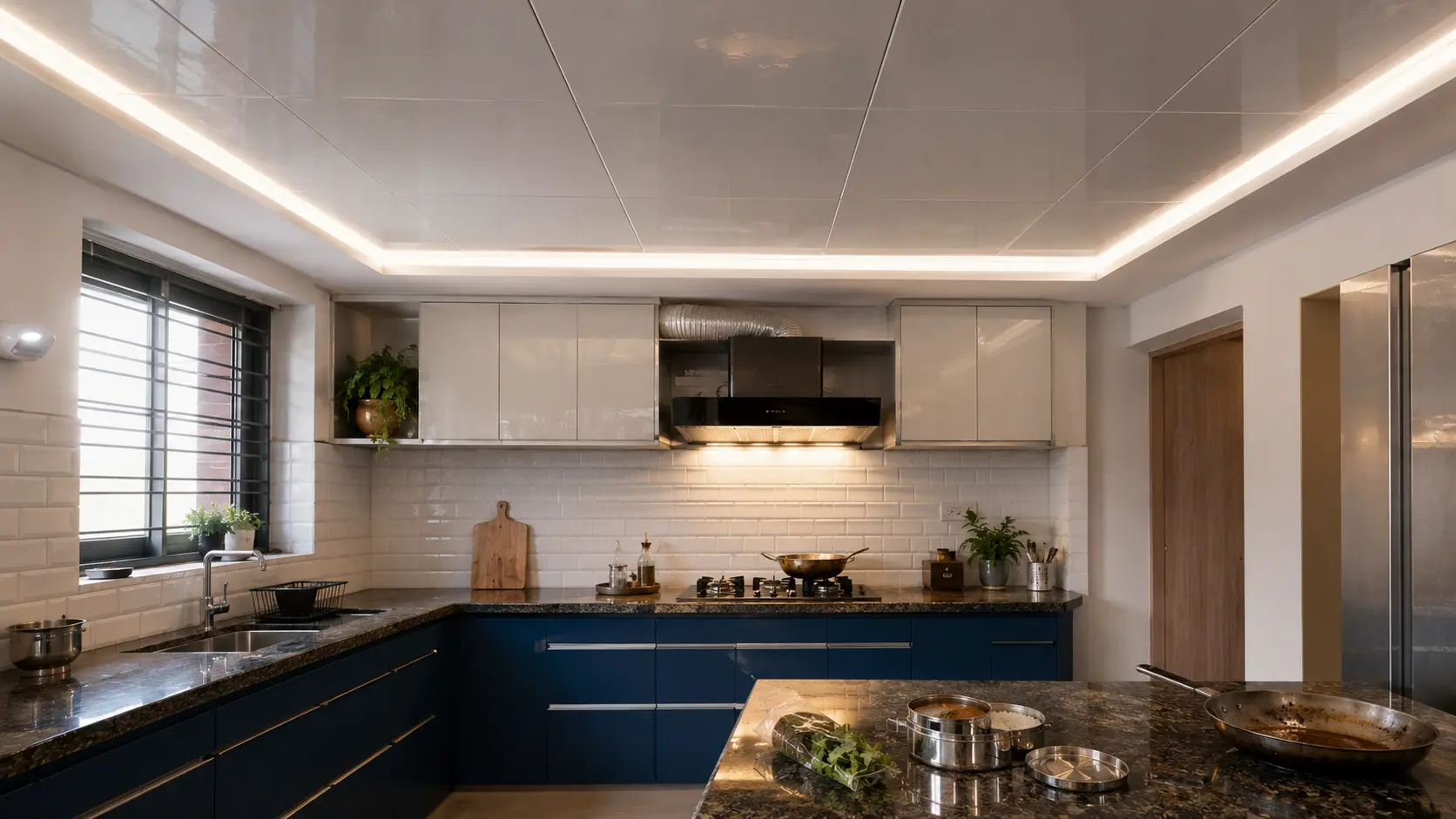
PVC False Ceiling in Bangalore
Moisture-resistant PVC ceilings for kitchens, bathrooms, balconies, and utility areas — the right answer where gypsum and POP would fail.
60+ PVC Ceiling projects in Bangalore
What is PVC False Ceiling?
PVC false ceiling panels are hollow extrusions of polyvinyl chloride — long, lightweight strips with a tongue on one edge and a groove on the other. They snap together horizontally on a simple metal or wooden sub-frame, leaving no visible joints and needing no paint. The panels are factory-finished, so the surface you see at installation is the surface that stays for the next decade.
The reason PVC exists in the Bangalore ceiling catalogue is moisture. Gypsum boards swell when they sit under sustained steam exposure; POP plaster crazes when humidity stays above 80% for weeks at a time. PVC does neither — the material is dimensionally inert in water, fungus-resistant by chemistry, and unaffected by the kind of splash exposure that ruins everything else. That makes it the default ceiling for kitchens, bathrooms, balconies, basements, and utility rooms across the city.
PVC is not perfect. Held under direct sunlight for years, the panels can yellow at the edges. The hollow profiles read as functional rather than design-led, so a PVC ceiling in a drawing room would look out of register. Treat PVC as the right answer where moisture or splash makes it the only durable option — and use gypsum or POP everywhere else.
Why Choose PVC False Ceiling?
-
Moisture resistance
PVC is dimensionally inert in water. A kitchen ceiling installed in PVC will not swell, sag, or warp from cooking steam over a 10-year horizon — gypsum or POP in the same space would fail within two monsoons.
-
No painting needed
Panels arrive factory-finished in plain, wood-grain, marble, or printed designs. The finish you install is the finish that stays — no primer coat, no paint cycles, no touch-ups. Hand-over is the same day as installation completion.
-
Lightweight install
A full PVC ceiling weighs a fraction of a gypsum or cement-board equivalent. The sub-frame can be lighter, the load on the slab is minimal, and the panels can be carried up by two people. Useful for upper-floor balconies and older buildings where structural margins are tighter.
-
Fast installation
A standard kitchen or balcony PVC ceiling installs in 2 to 4 working days — sub-frame on day one, panels and edge trims on day two or three, final inspection. Most installations finish faster than the moisture testing of a gypsum ceiling would even start.
-
Fungus resistance
PVC has no organic content for mould to colonise. Even in poorly ventilated bathrooms where gypsum would develop black spotting within a year, PVC stays clean. We still recommend exhaust fans, but the ceiling itself is mould-immune.
How We Install PVC False Ceiling
-
Frame fixing
A galvanised metal or treated wooden sub-frame is anchored to the slab, levelled with a laser, and braced at the edges. The frame spacing is set for the specific panel width and the room geometry.
-
First panel installation
The first PVC panel is fixed against a starting wall edge with mechanical clips or screws hidden along the tongue. This sets the alignment for every panel that follows.
-
Sequential panel snapping
Each subsequent panel snaps into the groove of the previous one — tongue-and-groove engagement that leaves no visible joint. The last panel along each wall is cut to fit and tucked under the edge trim.
-
Edge trim fitting
Perimeter trims cover the panel ends and the sub-frame edges, giving the ceiling a clean finished line where it meets the walls. Light points, exhaust fan cutouts, and any service penetrations are also trimmed at this stage.
-
Final inspection and handover
A walkthrough confirms every panel is flush, every trim is square, and every cutout is sealed. We hand over the same day, with a written warranty against panel sagging, yellowing under typical interior light, and joint separation.
Materials We Use
-
Marbella
India-manufactured PVC panels with a strong reputation for consistent thickness and colourfast finishes. The default choice for Bangalore kitchen and bathroom installations — wide finish range, dependable batch quality, easy availability for future panel matching if a section ever needs replacing.
We use it for Kitchens, bathrooms, balconies, utility rooms
-
Greenply Decowood PVC
Greenply has been laminating PVC and engineered wood products for decades. Their Decowood PVC line is specified where the panel finish matters most — wood-grain reproductions sharp enough to read as veneer at a normal viewing distance.
We use it for Spaces wanting wood-grain finish without real wood
-
Asian Paints PVC
Asian Paints' PVC panels carry the brand's colour-and-finish discipline into ceiling work. Strong for utility areas in Bangalore commercial buildings where consistent specification across multiple floors matters.
We use it for Commercial buildings, hospitals, schools, multi-floor projects
PVC panels look similar at the shelf; they perform very differently after two Bangalore monsoons. The panel wall thickness, the tongue-and-groove tolerance, and the colourfast pigments are what separate a ceiling that stays bright for ten years from one that yellows in three.
Ideal For
Rooms
- Kitchens
- Bathrooms and powder rooms
- Balconies and verandahs
- Utility and washing areas
- Basement and parking ceilings
Property types
- Apartments (kitchen + utility zones)
- Villas (kitchen + balconies)
- Commercial kitchens
- Hospitals and clinics
- Schools and educational buildings
PVC is the right ceiling wherever moisture, splash, or sustained humidity is part of the room’s normal operating condition. For living rooms and bedrooms, use gypsum; for traditional spaces with cornice work, use POP; everywhere wet, use PVC.
Frequently Asked Questions About PVC False Ceiling
Will PVC panels yellow or fade over the years?
Branded PVC panels with proper UV-stable pigments hold their colour for 10 to 12 years in normal interior light. The yellowing risk is real but specific — it shows up where panels sit under direct sunlight for hours every day (sun-facing balconies without shading) or near fluorescent tubes positioned within an inch of the panel face. Marbella, Greenply, and Asian Paints panels installed in standard kitchens and bathrooms do not yellow noticeably over the warranty period. We confirm the lighting and sun exposure during the site visit before recommending PVC.
How does PVC perform vs gypsum in long-term Bangalore monsoon exposure?
PVC wins decisively wherever there is any moisture exposure. Gypsum boards swell with sustained humidity above 75% and start sagging within a couple of monsoons in unventilated bathrooms or kitchens. PVC is dimensionally inert in water — the same panel after ten monsoons in a Bangalore kitchen looks identical to the day it was installed. For dry interior spaces (living rooms, bedrooms), gypsum is the better choice on aesthetics and design flexibility. The line between them is the wet-zone boundary.
What is the difference between PVC false ceiling and PVC wall panelling?
The panels themselves are essentially the same product — hollow PVC extrusions. The difference is orientation and use case. False ceiling panels install horizontally on a sub-frame below the slab; wall panelling installs vertically against the wall surface. See our PVC panelling page for wall applications. We often install both in the same room (full bathroom in PVC, ceiling and walls) for a fully wipe-clean envelope.
Is PVC suitable for living rooms or bedrooms?
Functionally yes — PVC will not fail in a dry living room or bedroom. But aesthetically the panel system reads as functional rather than design-led: the joint lines are visible at a normal viewing distance, and the finish range is narrower than gypsum or wood. For most Bangalore homeowners, gypsum is the better living-room and bedroom answer. We use PVC in residential dry zones only on specific requests — typically when budget, fast install, or a moisture-prone position (like a bedroom directly under a leaking slab above) drives the choice.
How long does PVC last in Bangalore humidity?
A correctly installed PVC ceiling on branded panels lasts 10 to 12 years before any panel replacement is needed — sometimes longer in dry conditions, slightly shorter under high direct-sun exposure. We offer warranties of up to 10 years on PVC installations, covering panel sagging, yellowing under normal interior light, and joint separation. Individual panel replacement is straightforward — the snap-fit system means a damaged panel can be swapped out in under an hour without disturbing the rest of the ceiling.
Get a Free Quote for PVC False Ceiling in Bangalore
Tell us about your space — we'll send a written, itemised quote after a free site visit.