The short answer
For most Bangalore homes built after 2010, gypsum is the right answer — faster install, sharper edges, more design flexibility, and easier to maintain. POP wins when the design calls for ornamental cornice work, traditional ceiling-rose detail, or a finish that matches the character of an older Bangalore home. This is not a winner-takes-all comparison; it’s a fit-to-purpose decision. Here’s why, line by line.
What’s the actual difference?
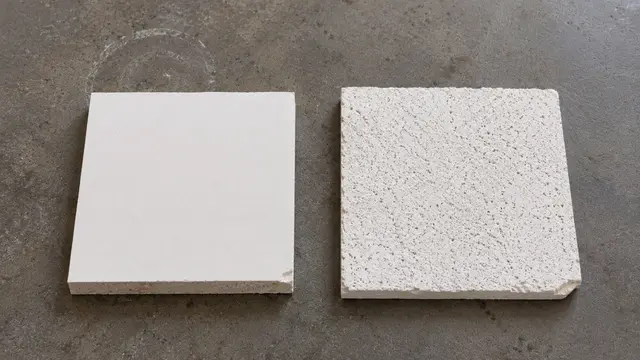
Gypsum false ceilings use factory-made boards — typically 12.5 mm Saint-Gobain Gyproc or USG Boral — fixed to a metal sub-frame suspended from the slab. The boards arrive at consistent thickness, with sharp edges and a smooth paper face. Joints are taped, embedded in joint compound across three progressive coats, and sanded between coats. The finish is paint-ready in roughly a week for a 3BHK.
POP ceilings — Plaster of Paris — are wet-applied. A wooden batten frame is nailed up, chicken mesh stapled across as the substrate, and POP plaster (usually Sakarni Gold, Trimurti, or J.K. White) is troweled on in three coats: scratch, levelling, and finish. Cornice profiles and ceiling roses are hand-laid using template knives. The process takes longer because each coat needs to cure before the next goes on.
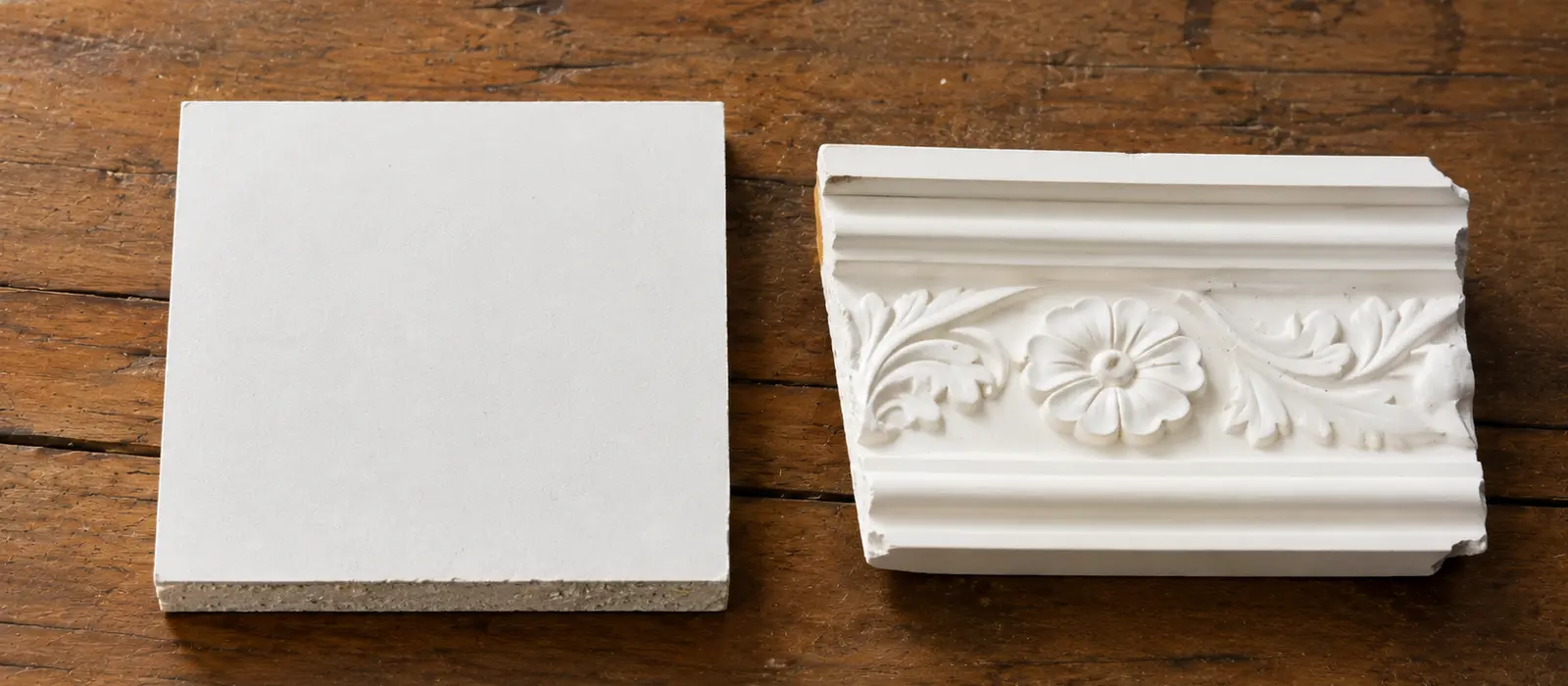
The visible difference at handover is subtle in the field (modern POP work with a good finishing coat reads close to gypsum at first glance), but it shows up in the details: the edges where the ceiling meets the wall, the corners where two levels intersect, and any decorative profile. Gypsum gives you a machine-sharp line; POP gives you the hand-laid character of a plaster finish.
Lifespan and what affects it
In Bangalore conditions, both materials hold their finish for a long time when installed correctly:
-
Gypsum — 12 to 20 years before any repaint is needed, provided there’s no water leak from the slab above. The board itself stays dimensionally stable as long as moisture is kept out. The most common failure mode is monsoon water seepage from a terrace above the slab, which is a building problem, not a ceiling-material problem.
-
POP — 8 to 15 years for the visible finish before hairline cracking shows at the cornice corners or along the field. POP is dimensionally more responsive to humidity than gypsum, so it micro-cracks earlier in the cycle. The cornice profile itself stays sound much longer; the issue is usually the field flatness over time.
Both lifespans assume professional installation, a sound substrate, and an intact roof slab above. A leaky terrace shortens both materials to less than a year. Our written warranty covers up to 15 years on select systems, and we’ve seen installations from our earliest 2018 projects still holding finish without callbacks.
Design freedom — what each can do
This is where the two materials genuinely diverge.
Gypsum is the modern designer’s preferred material because it’s so flexible:
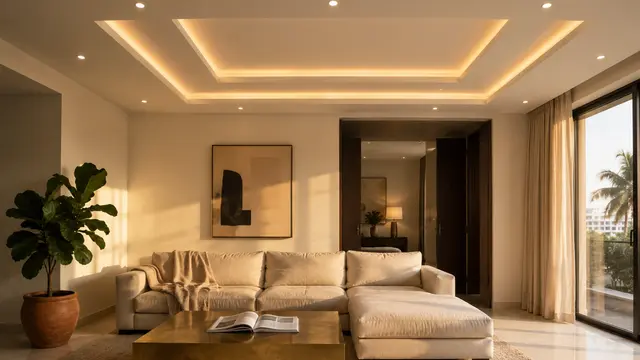
- Multi-layer drops and stepped recesses for cove lighting
- Sharp 90-degree edges that hold visibly even at viewing distance
- Smooth flat fields across large rooms without telegraphing joints
- Continuous profile across doorways and room boundaries
- Curved edges (with 9 mm flexible Gyproc bending to small radii) for circular recesses or curved coves
- Concealed integrations for AC ducting, fire-sprinkler heads, and recessed lighting
POP is the traditional choice because it’s where ornamental detail still lives:
- Multi-tier cornice profiles (three-tier, four-tier, five-tier) hand-laid along the perimeter
- Central ceiling-rose mouldings, often around a pendant or chandelier drop
- Decorative wall friezes that continue from the ceiling
- Restoration work on existing cornice in older Bangalore homes (1960s–1980s residential stock where POP was the default)
Pictures of “gypsum vs POP” online are misleading because both can do simple flat field work that looks identical from across a room. The real design-freedom difference shows up in the details — and which detail your design needs is what dictates the choice.
What the brands actually mean
When a contractor quotes “Saint-Gobain Gyproc,” that brand name covers multiple product lines: a standard residential board, a higher-density acoustic-rated board, a moisture- resistant board for wet zones, and a fire-rated board for compartment boundaries. The quote should specify which line — “Saint-Gobain Gyproc 12.5 mm standard” for a living-room ceiling, “Saint-Gobain Habito” for an acoustic master bedroom, “Saint-Gobain Aquaboard” for a kitchen ceiling. Substituting a different product line within the same brand is the most common silent shortcut in Bangalore residential gypsum work.
The same applies to POP. Sakarni makes Sakarni Gold (the higher residential grade), Sakarni Standard, and Sakarni Punning POP (a finishing-coat formulation). Trimurti and J.K. White each have multiple product lines. The brand name alone isn’t a specification — the line within the brand is what determines the install life. See our quote-reading guide for the line items every quote should specify.
Installation time
For a typical 3BHK apartment with new ceiling work in living, dining, and bedrooms:
- Gypsum: 7 to 10 working days on site, plus 1 to 2 days for the painter to follow up after handover
- POP: 10 to 14 working days on site (the cure intervals between coats are the main difference), plus 1 to 2 days for the painter
For a villa with cornice work in formal rooms, POP can stretch to 14–18 working days because the hand-laid cornice profile takes a skilled installer time to lay properly across long perimeter runs.
Faster contractors will quote shorter timelines for both. Be careful — a quoted 3-day gypsum 3BHK or 5-day POP villa is usually cutting corners somewhere (missing joint compound coats, skipping cure intervals, or thinning the brand spec). See our quote-reading guide for the specific line items that signal corner-cutting.
Repairing damage
When ceilings get damaged — a water leak, a hard impact, a mounting failure — the repair experience differs:
Gypsum repair is straightforward when the substrate is intact. The damaged section of board can be cut out, replaced with a matching panel, the joint re-taped, and the finish re-painted. A skilled installer can patch a 2-foot-square gypsum section so it’s invisible after paint. Cost and timeline are modest — typically 2 to 3 working days for a single-room repair.
POP repair is more involved. POP is wet-applied, so the patch material has to be remixed to match the existing field’s porosity and finish. Cornice repair is the hardest case — the template profile has to match the existing cornice exactly, or the repair reads as a patch even after paint. A skilled POP installer can do this work, but it takes longer (4 to 6 working days for a single-room cornice + field repair) and the result is more visually critical.
For both materials, the quality of the repair depends entirely on the skill of the installer. If the original installation was substandard, the repair will be too.
The verdict — which one for which home
After 500+ projects across Bangalore, here’s the practical decision rule we apply on every site visit:
Pick gypsum if:
- Your home is a recent build (post-2010 apartment, new villa, modern fit-out)
- The design favours clean lines, flat fields, and concealed cove lighting
- You need fast turnaround
- You want maximum design flexibility for future updates
- The space has standard ceiling heights and the design is contemporary
Pick POP if:
- The home has existing POP cornice you want to preserve or match
- The design calls for ornamental detail — multi-tier cornice, ceiling roses, decorative friezes
- You’re in an older Bangalore home (Jayanagar, Malleswaram, Frazer Town, Cox Town) where POP fits the character
- You appreciate hand-laid plaster craft and the design brief allows for it
- The room has high ceilings that accommodate ornate detailing without feeling crowded
A small but growing number of our projects combine both — a gypsum field with a hand-laid POP cornice at the perimeter, or a POP-punned wall finish on the new gypsum drop. The two materials don’t compete; they cover different parts of the design vocabulary.
| Quick reference | Gypsum | POP |
|---|---|---|
| Typical install (3BHK) | 7–10 days | 10–14 days |
| Lifespan in Bangalore | 12–20 years | 8–15 years |
| Design strength | Modern, flat, layered | Traditional, ornate, cornice |
| Edge quality | Machine-sharp | Hand-laid character |
| Repair difficulty | Straightforward | More skilled work needed |
| Brand examples | Saint-Gobain Gyproc, USG Boral | Sakarni, Trimurti, J.K. White |
The right answer for your home depends on what you’re trying to achieve — and that’s a 20-minute conversation on site, not a generic recommendation from an article. Book a free site visit and we’ll walk through the room with you. We bring samples of both materials, and we’ll tell you honestly which one fits.